
Hyundai Creta: Brake System / Brake Booster
Components and components location
| Components |
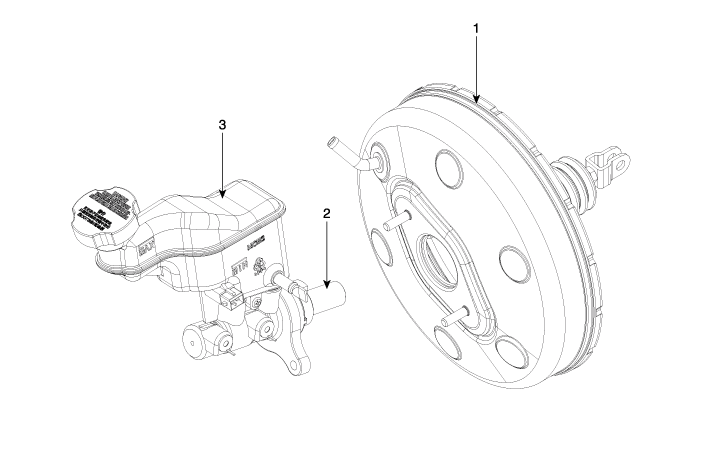
| 1. Brake booster 2. Master cylinder assembly |
3. Reservior |
Repair procedures
| Brake Booster Operating Test |
For simply checking the brake booster operation, perform the following tests.
| 1. |
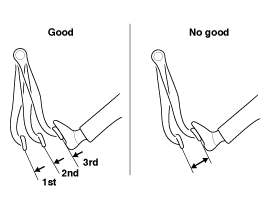
Run the engine for one or two minutes, and then stop it. Depress the
pedal several times, and if the pedal stroke gradually decreases, the
brake booster operates properly. If there is no change, the booster
is faulty.
|
| 2. |
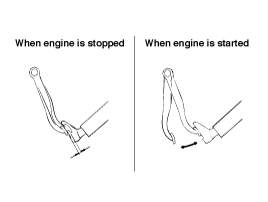
With the engine stopped, step on the brake pedal several times.
Then step on the brake pedal and start the engine. If the pedal moves
downward slightly, the booster is in good condition. If there is no
change, the booster is inoperative.
|
| 3. |
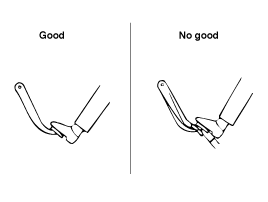
With the engine running, step on the brake pedal and then stop the engine.Hold
the pedal depressed for 30 seconds. If the pedal height does not change,
the booster is in good condition, if the pedal rises, the booster is
inoperative.
If the three tests mentioned above result in good condition, the booster
performance can be determined as good.
Even if one of the three tests mentioned above is not in good condition,
check the check valve, vacuum hose and booster for malfunction.
|
| Removal |
[LHD]
| 1. |
Turn ignition switch OFF and disconnect the negative (-) battery cable.
|
| 2. |
Disconnect the battery positive terminal and then remove the battery.
|
| 3. |
Disconnect the ECM connector and then ECM and battery tray.
|
| 4. |
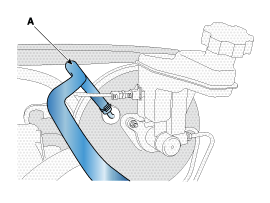
Disconnect the vacuum hose (A) from the brake booster.
|
| 5. |
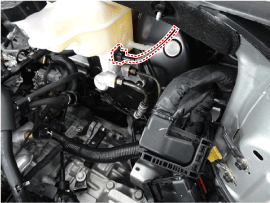
Disconnect the brake fluid level switch connector from the reservoir.
|
| 6. |
Remove the master cylinder.
(Refer to Brake Sysem - "Master Cylinder")
|
| 7. |
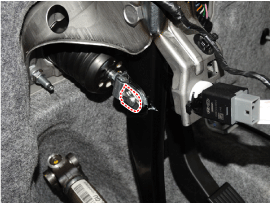
Remove the snap pin and clevis pin
|
| 8. |
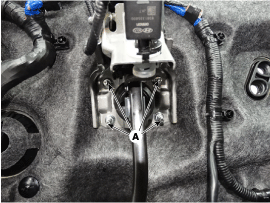
Remove the mounting nuts.
|
| 9. |
Remove the brake booster.
|
[RHD]
| 1. |
Turn ignition switch OFF and disconnect the negative (-) battery cable.
|
| 2. |
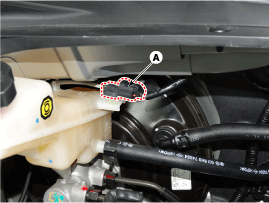
Disconnect the brake fluid level sensor connector (A).
|
| 3. |
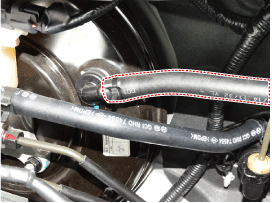
Disconnect the vacuum hose from the brake booster.
|
| 4. |
Remove the brake fluid from the master cylinder reservoir with a syringe.
|

| 5. |
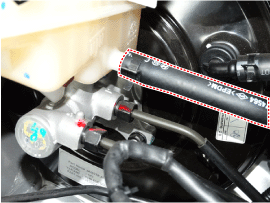
Remove the brake fluid hose from the reservoir. [M/T only]
|
| 6. |
Remove the brake master cylinder.
(Refer to Brake System - "Master Cylinder")
Remove the snap pin and clevis pin
|
| 7. |
Remove the mounting nuts.
|
| Inspection |
| 1. |
Inspect the vacuum hose.
|
| 2. |
Check the boot for damage.
|
| Installation |
| 1. |
Install in the reverse order of removal.
|
| 2. |
After installing, bleed the brake system.
(Refer to Brake Sysem - "Brake System Bleeding")
(Refer to ESP (Electronic Stability Program) System - "ESP System Bleeding")
(Refer to ABS (Anti - Lock Brake System) - "ABS System Bleeding")
|
 Repair procedures
Operation and Leakage Check
Check all of the following items :
Component
Procedure
Brake Booster (A)
Check brake operation by ...
 Master Cylinder
Components and components location
Components
1. Brake booster
2. Master cylinder assembly
3. Reservior
Repair procedures
Removal
...
Other information:
Hyundai Creta GS 2014-2019 Service Manual: Front Door Window Glass
Components and components location
Component Location
1. Front door window glass
Repair procedures
Replacement
1.
Remove the front door trim.
(Refer to Front Door - "Front Door Trim")
...
Hyundai Creta GS 2014-2019 Service Manual: SS-A Solenoid Valve (ON/OFF)
Description and operation
Description
•
SS-A solenoid valve is attached to the valve body and is an on/off solenoid
valve that is used to change gears.
•
SS-A Solenoid valve (ON/OFF) is installed at valve body.
...
© 2017-2026 www.hcrmangs.com
