
Hyundai Creta: Exhaust Emission Control System / CVVT (Continuously Variable Valve Timing) System: Description and operation
Hyundai Creta GS 2014-2019 Service Manual / Emission Control System / Exhaust Emission Control System / CVVT (Continuously Variable Valve Timing) System: Description and operation
| Description |
Continuous Variable Valve Timing (CVVT) system advances or retards the valve
timing of the intake and exhaust valve in accordance with the ECM control signal
which is calculated by the engine speed and load.
By controlling CVVT, the valve over-lap or under-lap occurs, which makes better
fuel economy and reduces exhaust gases (NOx, HC) and improves engine performance
through reduction of pumping loss, internal EGR effect, improvement of combustion
stability, improvement of volumetric efficiency, and increase of expansion work.
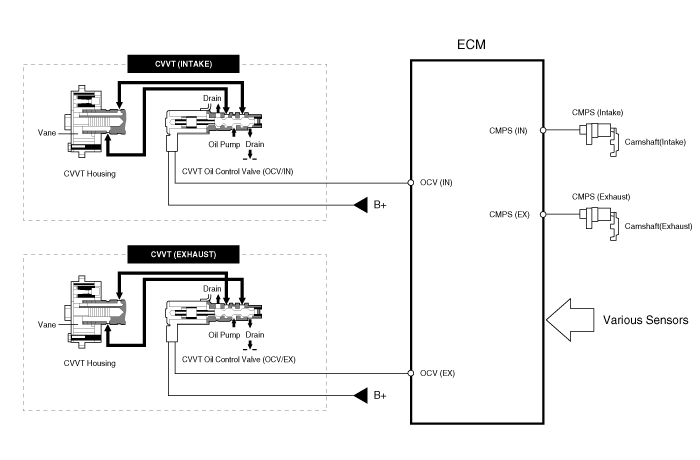
This system consist of
| • |
The CVVT Oil Control Valve (OCV) which supplies the engine oil to the
cam phaser or runs out the engine oil from the cam phaser in accordance
with the ECM PWM (Pulse With Modulation) control signal, the CVVT Oil
Temperature Sensor (OTS) which measures the engine oil temperature,
and the Cam Phaser which varies the cam phase by using the hydraulic
force of the engine oil.
|
The engine oil getting out of the CVVT oil control valve varies the cam phase
in the direction (Intake Advance/Exhaust Retard) or opposite direction (Intake
Retard/Exhaust Advance) of the engine rotation by rotating the rotor connected
with the camshaft inside the cam phaser.
| Operation Principle |
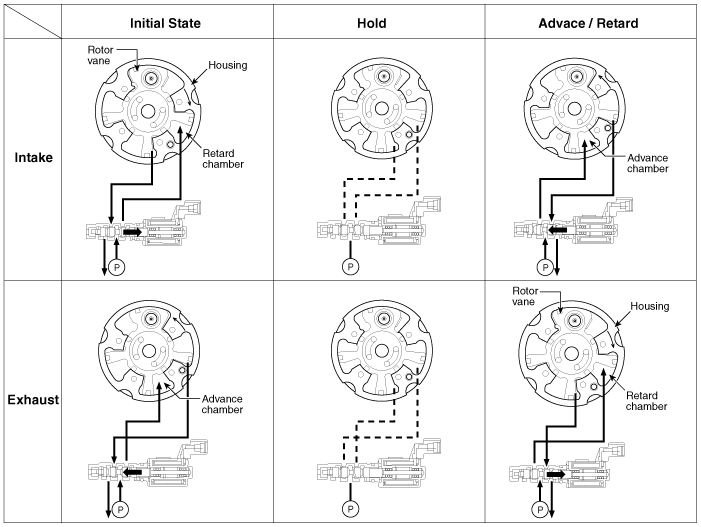
The CVVT has the mechanism rotating the rotor vane with hydraulic force generated
by the engine oil supplied to the advance or retard chamber in accordance with
the CVVT oil control valve control.
| [CVVT System Mode] |
|
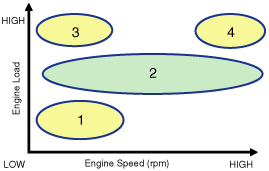
(1) Low Speed / Low Load |
(2) Part Load |
|
|
|
|
(3) Low Speed / High Load |
(4) High Speed / High Load |
|
|
|
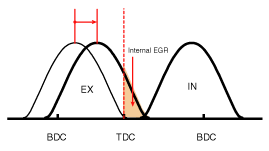
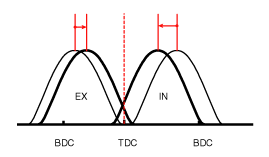
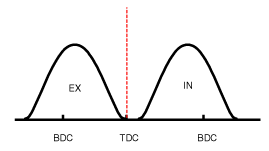
|
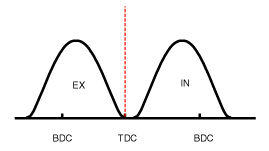
Driving Condition |
Exhaust Valve |
Intake Valve |
||
|
Valve Timing |
Effect |
Valve Timing |
Effect |
|
|
(1) Low Speed /Low Load |
Completely Advance |
* Valve Under-lap * Improvement of combustion stability |
Completely Retard |
* Valve Under-lap * Improvement of combustion stability |
|
(2) Part Load |
Retard |
* Increase of expansion work * Reduction of pumping loss * Reduction of HC |
Retard |
* Reduction of pumping loss |
|
(3) Low Speed /High Load |
Retard |
* Increase of expansion work |
Advance |
* Prevention of intake back flow (Improvement of volumetric efficiency) |
|
(4) High Speed /High Load |
Advance |
* Reduction of pumping loss |
Retard |
* Improvement of volumetric efficiency |
 Catalytic Converter: Description and operation
Description
The catalytic converter of the gasoline engine is a three way catalyst. It oxidizes
carbon monoxide and hydrocarbons (HC), and separates oxygen from the oxides
of nit ...

Other information:
Hyundai Creta GS 2014-2019 Service Manual: Description and operation
Description
If the Gasoline Engine Control system components (sensors, ECM, injector, etc.)
fail, interruption to the fuel supply or failure to supply the proper amount
of fuel for various engine operating conditions will result. The following situations
may be encountered.
...
Hyundai Creta GS 2014-2019 Service Manual: Water pump
Components and components location
Components
1. Gasket
2. Water pump
3. Water pump pulley
Repair procedures
Removal
1.
Drain the coolant.
(Refer to Cooling System - "Coolant")
2 ...
© 2017-2026 www.hcrmangs.com
