
Hyundai Creta: Air Conditioning System / Refrigerant Line
Components and components location
| Components Location |
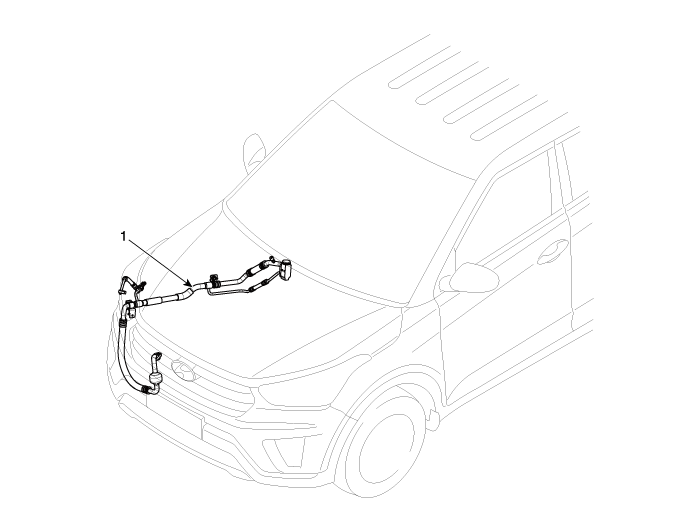
| 1. Refrigerant Line Assembly |
Repair procedures
| Replacement |
| 1. |
If the compressor is marginally operable, run the engine at idle speed,
and let the air conditioning work for a few minutes, then shut the engine
off.
|
| 2. |
Disconnect the negative (-) battery terminal.
|
| 3. |
Recover the refrigerant with a recovery/charging station.
|
| 4. |
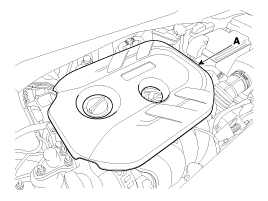
Remove the engine cover (A).
|
| 5. |
Remove the bolts and the expansion valve (A) from the evaporator core.
|
| 6. |
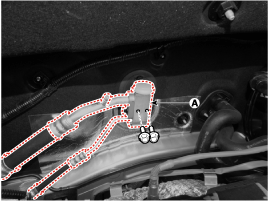
Disconnect the A/C pressure transducer connector (A).
|
| 7. |
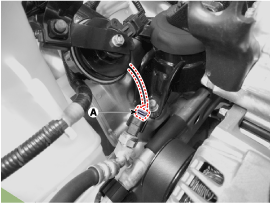
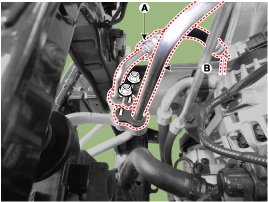
Remove the 2 nuts, and then disconnect the discharge line (A) and liquid
line (B) from the condenser.
|
| 8. |
Remove the engine room under cover.
(Refer to Engine Mechanical System - " Engine Room Under Cover")
|
| 9. |
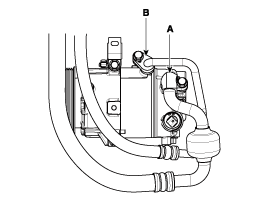
Remove the bolts, then disconnect the suction line (A) and discharge
line (B) from the compressor.
|

| 10. |
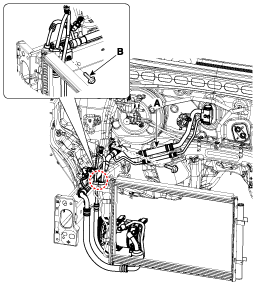
Loosen the bracket mounting bolt (B) from suction& liquid assembly (A).
|
| 11. |
Remove the refrigerant line assembly (A) to the upper of engine room.
|
| 12. |
Install in the reverse order of removal.
|

 Compressor oil: Repair procedures
Oil Specification
1.
The HFC-134a system requires synthetic (PAG) compressor oil whereas
the R-12 system requires mineral compressor oil. The two oils must never
...
 Compressor
Description and operation
Description
The compressor is the power unit of the A/C system.
It is located on the side of engine block and driven by a V-belt of the engine.
The c ...
Other information:
Hyundai Creta GS 2014-2019 Owners Manual: Exterior overview
1. Front windshield wiper blades
2. Outside rearview mirror
3. Door
4. Windows
5. Head light
6. Front fog light
7. Daytime running light
8. Hood
9. Tires and wheels
â– Rear view
1. Antenna
2. Fuel filler lid
3. Rear parking assist system
4. Rear combination lamp
5. Rea ...
Hyundai Creta GS 2014-2019 Owners Manual: Good braking practices
WARNING
Whenever leaving the vehicle or
parking, always come to a complete
stop and continue to depress
the brake pedal. Move the shift
lever into the 1st gear (for manual
transaxle vehicle) or P (Park, for
automatic transaxle vehicle) position,
then apply the parking brake,
and pla ...
© 2017-2026 www.hcrmangs.com
