
Hyundai Creta: Charging System / Description and operation
Hyundai Creta GS 2014-2019 Service Manual / Engine Electrical System / Charging System / Description and operation
| Description |
The charging system included a battery, an alternator with a built-in regulator,
and the charging indicator light and wire.
The Alternator has eight built-in diodes, each rectifying AC current to DC current.
Therefore, DC current appears at alternator "B" terminal.
In addition, the charging voltage of this alternator is regulated by the battery
voltage detection system.
The alternator is regulated by the battery voltage detection system. The main
components of the alternator are the rotor, stator, rectifier, capacitor brushes,
bearings and V-ribbed belt pulley. The brush holder contains a built-in electronic
voltage regulator.
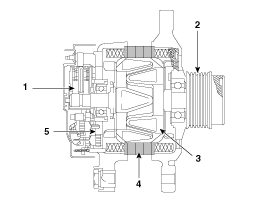
| 1. Brush 2. Drive belt pulley (OAD : Overrunning Alternator Decoupler) 3. Rotor 4. Stator 5. Rectifier |
| Alternator Management System |
Alternator management system controls the charging voltage set point in order
to improve fuel economy, manage alternator load under various operating conditions,
keep the battery charged, and protect the battery from over-charging. ECM controls
generating voltage by duty cycle (charging control, discharging control, normal
control) based on the battery conditions and vehicle operating conditions.
The system conducts discharging control when accelerating a vehicle. Vehicle
reduces an alternator load and consumes an electric power form a battery.
The system conducts charging control when decelerating a vehicle. Vehicle increases
an alternator load and charges a battery.
 Charging System
...
 Repair procedures
On-vehicle Inpection
•
First of all, check for DTCs. If a DTC is present, perform tro ...
Other information:
Hyundai Creta GS 2014-2019 Owners Manual: Rear combination light bulb
replacement
(1) Stop/Tail light
(2) Tail light
(3) Rear turn signal light
(4) Back-up light
Outside light
1. Open the tailgate
2. Loosen the light assembly retaining
screws with a cross-tip screwdriver.
3. Remove the rear combination light
assembly from the body of the
vehicle.
4. Remove ...
Hyundai Creta GS 2014-2019 Service Manual: Description and operation
Warning Lamp Activation
Warning Lamp Behavior
after Ignition On
As soon as the operating voltage is applied to the SRSCM ignition input, the
SRSCM activates the warning lamp for a LED lamp check.
The lamp shall turn on for 6 seconds during the initialization ...
© 2017-2026 www.hcrmangs.com
