
Hyundai Creta: Evaporative Emission Control System / Schematic diagrams
Hyundai Creta GS 2014-2019 Service Manual / Emission Control System / Evaporative Emission Control System / Schematic diagrams
| Schematic Diagram |
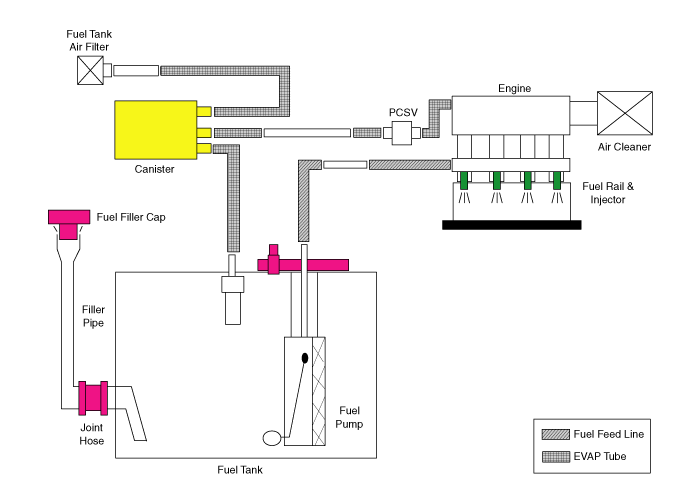
Canister
Canister is filled with charcoal and absorbs evaporated vapor in fuel tank.
The gathered fuel vapor in canister is drawn into the intake manifold by the
ECM/PCM when appropriate conditions are set.
Purge Control Solenoid Valve (PCSV)
Purge Control Solenoid Valve (PCSV) is installed in the passage connecting canister
and intake manifold. It is a duty type solenoid valve and is operated by ECM/PCM
signal.
To draw the absorbed vapor into the intake manifold, the ECM/PCM will open the
PCSV, otherwise the passage remains closed.
Fuel Filler Cap
A ratchet tightening device on the threaded fuel filler cap reduces the chances
of incorrect installation, which would seal the fuel filler. After the gasket
on the fuel filler cap and the fill neck flange contact each other, the ratchet
produces a loud clicking noise indicating the seal has been set.
 Description and operation
Description
Evaporative Emission Control System prevents fuel vapor stored in fuel tank
from vaporizing into the atmosphere. When the fuel evaporates in the fuel tank,
the vapor ...
 Canister: Repair procedures
Removal
1.
Remove the fuel tank.
(Refer to Fuel Delivery System - "Fuel Tank")
2.
Disconnect the vapor hose quick-connect ...
Other information:
Hyundai Creta GS 2014-2019 Service Manual: Troubleshooting
Troubleshooting
•
The battery must be in good condition and fully charged for
this troubleshooting.
...
Hyundai Creta GS 2014-2019 Owners Manual: Power outlet
The power outlet is designed to provide
power for mobile telephones or
other devices designed to operate
with vehicle electrical systems. The
devices should draw less than 180W
(Watt) with the engine running.
WARNING
Avoid electrical shocks. Do not
place your fingers or foreign
obj ...
© 2017-2026 www.hcrmangs.com
